
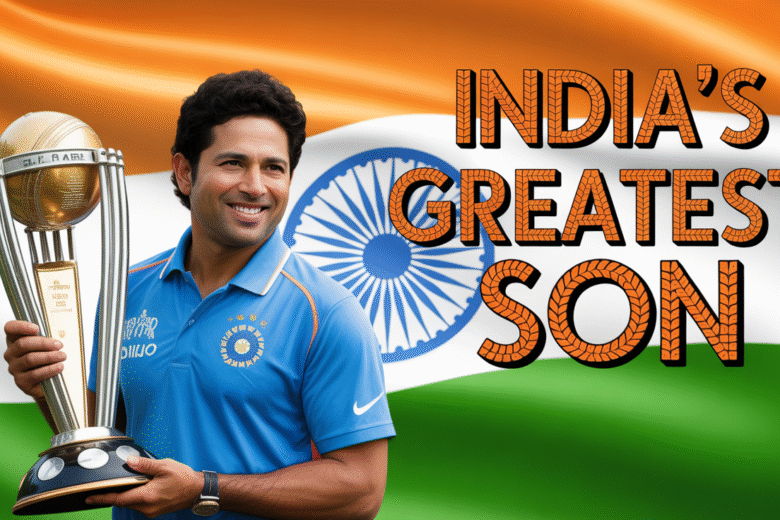
In India, cricket is not just a sport; it is a religion. And for a generation, Sachin Ramesh Tendulkar was its deity. He was the one-man army who carried the hopes and dreams of a billion people on his shoulders every time he stepped onto the field. His career was an epic saga that spanned a quarter-century, filled with breathtaking highs, heartbreaking lows, and a mountain of records that may never be broken. But to truly understand Sachin is to look beyond the numbers. It is to understand what his presence meant to a nation starved of global heroes, a nation that found a reason to believe in itself through the strokes of his bat.
The Prodigy from Mumbai: A Destiny Unfolding
Born on April 24, 1973, in Mumbai, Sachin’s life was destined for greatness from the very beginning. His father, a Marathi poet and novelist, named him after the legendary music director Sachin Dev Burman. But it was his elder brother, Ajit Tendulkar, who first spotted the spark of genius in him. Ajit, recognizing his younger brother’s immense talent, enrolled him at a young age in the academy of the legendary coach Ramakant Achrekar. This was the turning point. Under Achrekar’s strict and unconventional coaching, Sachin’s raw talent was honed into a force of nature. He would be made to play on the same wicket for hours, and if he remained not out, Achrekar would put a one-rupee coin on top of the stumps for him to claim. Sachin famously collected thirteen of these coins, a testament to his unbreakable concentration and resolve.
His talent became a subject of folklore long before he ever played for India. As a 14-year-old, he, along with his schoolmate Vinod Kambli, put together a world-record partnership of 664 runs in a school match, a feat that made headlines across India. At just 15, he made his first-class debut for Mumbai and scored a century, a sign that he was ready for the big stage.
The Baptism of Fire: A Teenager Takes on the World
At the tender age of 16 years and 205 days, Sachin Tendulkar was called up to the Indian national team for a tour of Pakistan. It was a baptism by fire. He was a small, unassuming boy facing off against a formidable pace attack led by the fearsome duo of Waqar Younis and Wasim Akram, arguably the two most lethal fast bowlers of that era. In one of the Test matches, he was hit on the nose by a bouncer from Waqar Younis, but instead of retreating, he refused medical attention and continued to bat, his face covered in blood. It was a moment that showed the world that this was no ordinary talent; this was a warrior.
His first international century came a year later in 1990 against England, a match-saving 119 not out that cemented his reputation as a prodigy. He was just 17. From that moment on, his career was an upward trajectory of dominance.
The Master Blaster Era: Records Galore and a Nation’s Hope
The 1990s and early 2000s were the golden age of Sachin Tendulkar. He transformed from a technically brilliant batsman into an aggressive “Master Blaster.” His move to opening the batting in ODIs in 1994 was a masterstroke, as he began to unleash a style of batting that was both explosive and elegant. He scored his first ODI century in his 79th match, and what followed was a whirlwind of record-breaking performances.
He was the undisputed face of Indian cricket, and every match was an event. As a fan, I remember the anticipation and the hush that would fall over the crowd when he walked out to bat. He became a symbol of hope for a young, rapidly growing India. The famous “Desert Storm” innings in Sharjah in 1998, where he scored back-to-back centuries against a dominant Australian side, is a moment that is seared into the memory of every cricket fan. He was almost single-handedly batting for his team and his country, a responsibility he carried with a poise that was almost unnatural.
He became a collector of records:
- 100 International Centuries: He is the only cricketer in history to achieve this mind-boggling feat, a testament to his longevity and consistency across formats.
- Most Runs in Tests & ODIs: He is the leading run-scorer in both Test and One Day International cricket, a record that has stood the test of time.
- First ODI Double Century: In 2010, he became the first male cricketer to score a double century in an ODI match, an innings that shattered all previous records and expectations.
- Most World Cup Appearances: He played in a record six World Cups, a testament to his enduring career.
The Ultimate Dream and the Emotional Farewell
Despite his individual brilliance, a major trophy with India had always eluded him. He was the highest run-scorer in the 1996 and 2003 World Cups, but the final prize remained just out of his reach. The 2011 World Cup, held in India, was his sixth and final chance. The pressure was immense. The team played for him, with the slogan “Do it for Sachin.” When India finally won the trophy at his home ground in Mumbai, the moment was filled with raw emotion. His teammates carried him on their shoulders around the stadium, a powerful image that was later named the Laureus Sporting Moment of the Year. It was a fitting culmination of a two-decade-long dream.
In 2013, after a career that spanned 24 years, Sachin Tendulkar played his 200th and final Test match at the Wankhede Stadium. His farewell speech was a masterclass in humility and gratitude, a perfect final act for a man who had always let his bat do the talking. The entire nation was in tears, a collective emotion that proved he was more than just a sportsman; he was a national treasure.
Beyond the Pitch: The Bharat Ratna and a Lasting Legacy
After his retirement, Sachin Tendulkar was honored with the Bharat Ratna, India’s highest civilian award, becoming the first sportsperson and the youngest recipient. This recognition was a testament to his impact not just on the field, but on the cultural fabric of the country. He has used his influence for philanthropy, focusing on health and sanitation projects, and has remained an active figure in the cricket world as a mentor and ambassador.
His legacy is not just about the records or the awards. It is about his quiet confidence, his impeccable sportsmanship, and his ability to carry the hopes of a nation with a smile. He was the perfect role model in an age of commercialization and a symbol of integrity and dedication. In a sport that continues to evolve, Sachin Tendulkar’s legacy remains untouched, a timeless reminder of what a single-minded pursuit of excellence can achieve.