

In the world of cricket, where aggression and flamboyance often dominate headlines, Mohammad Babar Azam presents a refreshingly classical contrast. He is a modern-day batting maestro whose game is defined by exquisite timing, impeccable technique, and a quiet but profound sense of calm. To watch him bat is to witness a blend of artistry and efficiency. He doesn’t muscle the ball; he caresses it, finding gaps with surgical precision. But his story is more than just a highlight reel of elegant cover drives. It’s a journey from the dusty lanes of Lahore to the pinnacle of world cricket, a testament to dedication and the unwavering support of a family that saw his potential long before the world did.
From the Walled City to the Big Stage
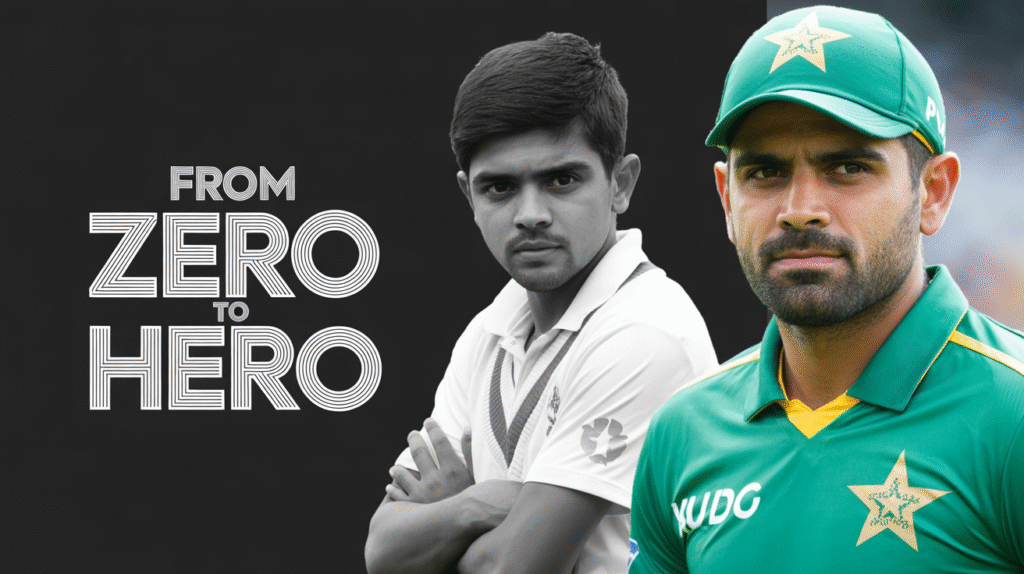
Born on October 15, 1994, in the historic Walled City of Lahore, Babar Azam’s early life was deeply intertwined with cricket. He was not born into a life of privilege but into a passionate cricketing family. His cousins, Kamran and Umar Akmal, were already established international cricketers, and their stories were his earliest source of inspiration. He spent his days watching them and dreaming of one day following in their footsteps. His first taste of professional cricket wasn’t with a bat in his hand, but as a ball boy at Gaddafi Stadium. He would sit on the boundary, soaking in the atmosphere and getting a front-row seat to the game’s greatest moments. It was here, in the stands and on the sidelines, that his burning desire to play for Pakistan was truly ignited.
His formal training began at a local cricket academy, where his first coach, Rana Sadiq, took him under his wing. Sadiq recognized his immense talent and taught him the fundamentals that would form the bedrock of his career. While his peers were focusing on power-hitting, Babar was perfecting his classical technique, building a game based on a strong foundation and textbook strokes. This focus on the basics set him apart and prepared him for the rigors of international cricket.
The Grinding Years and the Road to Pakistan
Babar’s journey through the ranks of domestic cricket in Pakistan was a gradual but steady climb. He was a prolific scorer at every level, representing his country in the Under-15 and Under-19 teams. He even captained the Under-19 team at the 2012 World Cup, an early sign of the leadership qualities that would define his later career. His performances consistently stood out, and he was soon a key player in Pakistan’s domestic setup.
In 2015, his hard work paid off when he was selected for the senior national team’s ODI squad for a series against Zimbabwe. He made his debut on May 31, 2015, scoring a solid fifty, a performance that announced his arrival on the international stage. It was a moment of immense pride for him and his family, a dream realized after years of tireless effort.
The King of the Middle Order: Batting Prowess and Record-Breaking Form
The period that followed his debut saw Babar Azam transform into one of the most consistent and dominant batsmen in the world. He became renowned for his ability to convert starts into big scores, a trait that was often missing in Pakistani cricket. In 2016, during a series against the West Indies, he scored three consecutive ODI centuries, a remarkable feat that earned him the record for the most runs in a three-match ODI series. This performance was a clear signal that he was not just another promising talent, but a potential legend in the making.
His game thrived in the white-ball formats, particularly ODIs and T20Is, where his ability to anchor an innings and accelerate at will was invaluable. He consistently climbed the ICC rankings, and in April 2021, he achieved a milestone that few cricketers ever reach: he became the number one ranked ODI batsman in the world, dethroning his idol, Virat Kohli. This achievement was a testament to his consistent performances over several years and a source of immense pride for his fans.
Captaincy and the Weight of Expectation
In 2019, Babar Azam was appointed as the captain of the Pakistan T20I team, a role that was later extended to all three formats. Leading the Pakistani national team is one of the most high-pressure jobs in cricket, and Babar handled it with his characteristic composure. As a captain, he instilled a sense of unity and professionalism in the squad. He led Pakistan to their first-ever series victory in Australia in a T20I series and also to the semifinals of the 2021 T20 World Cup. He also holds the unique distinction of being the only captain to lead Pakistan to the number one ODI team ranking.
However, his captaincy was not without its challenges. The pressure from the media and fans, especially after losses, was immense. In November 2023, after the Cricket World Cup, he stepped down from the captaincy in all three formats. This decision, though difficult, showed his humility and his willingness to put the team and his own performance first. He later regained the white-ball captaincy, a clear indication of the board’s and his teammates’ trust in his leadership.
Beyond the Boundaries: Personal Life and Style
Off the field, Babar Azam is a soft-spoken and private individual, a stark contrast to the aggression and intensity he shows on the pitch. He is widely respected for his humility and his strong work ethic. He has also become a major commercial brand, endorsing numerous national and international products, but he has always maintained a focus on his cricket. He is a role model for aspiring cricketers in Pakistan and around the world, proving that success can be achieved through a combination of hard work and a quiet, dignified resolve.
A Legacy in the Making
At just 29, Babar Azam’s story is still being written, and his career promises to break many more records. His journey is a powerful example of how a boy from a humble background can reach the pinnacle of his sport through dedication and an unshakeable belief in his own abilities. His elegant batting style and his calm demeanor under pressure have made him not just a national hero, but a global icon. He has taken the burden of immense expectation and turned it into an art form, a legacy of grace, skill, and triumph that will be remembered for generations to come.